

Your Home... Your Choice...
You probably don't know this, but you can keep the systems you have that use gas. It's already written into Local Law 97. The law gives you more than one way to comply. The City just hasn't set the "number" for low carbon gas, and until it does, buildings that could comply with the boilers they already own are being pushed toward rip-and-replace electrification they can't afford. And when the City sets it, it has to count the gas a building actually buys and has delivered through the pipeline, the same way it counts every other therm on the bill.
Set the number. Count the delivery.
Sign the petitionCall your elected officialWe won round one: the court put us back in the City's program.
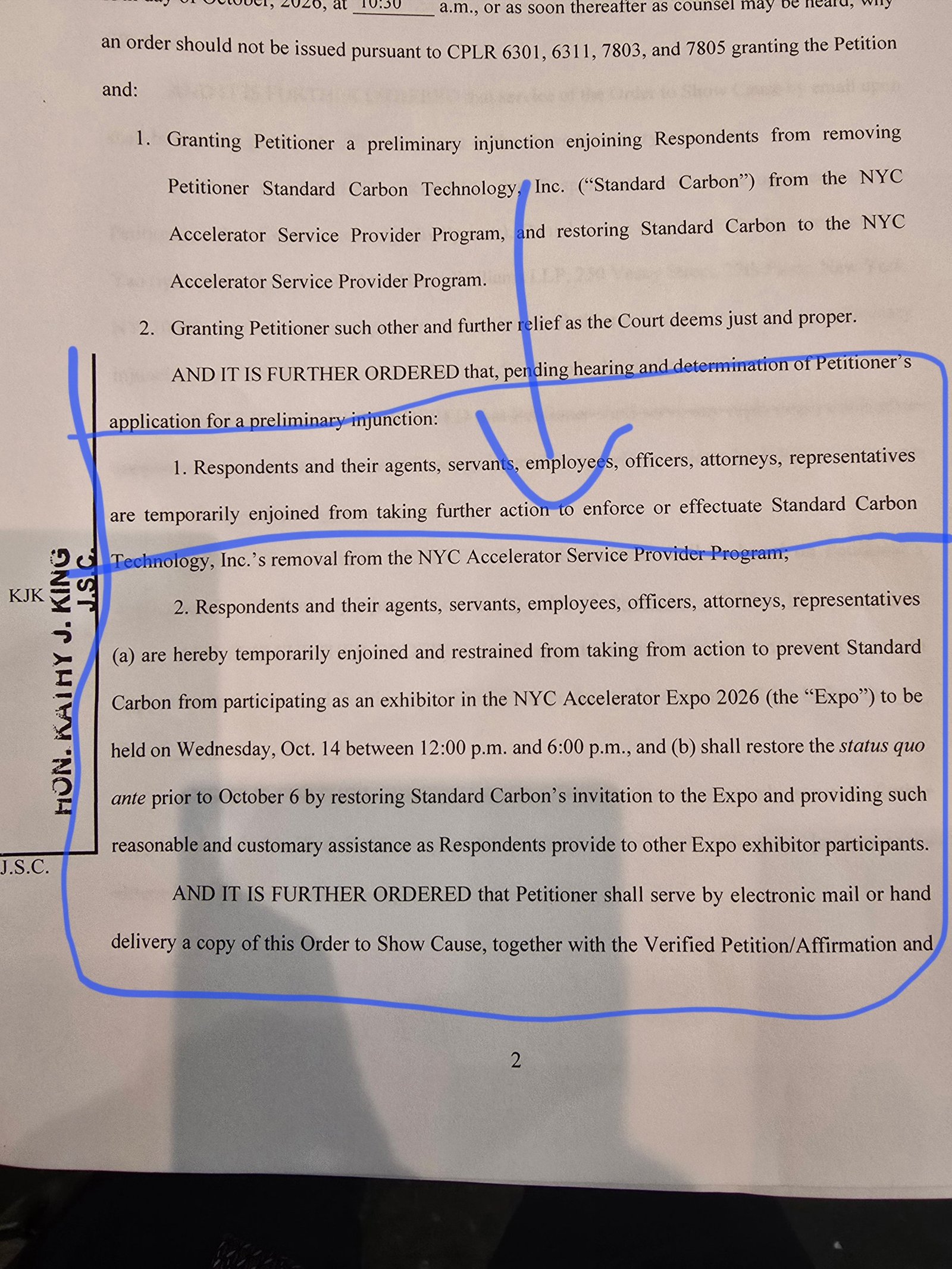
Our cowgas.com team is victorious! Today Justice Kathy J. King signed our temporary restraining order. It blocks the City from enforcing our removal from the NYC Accelerator Service Provider Program and restores our place as an exhibitor at the NYC Accelerator Expo while the case moves forward.
Read the full signed order (PDF, 4 pages)
Oral argument on our preliminary injunction is set for November 17, 2026 at 10 a.m.
We'll see you tomorrow at the NYC Accelerator Expo, noon to 6 p.m. at the Metropolitan Pavilion, 125 West 18th Street.

How we got here
Early this morning Standard Carbon filed an Article 78 petition, with an emergency request for a temporary restraining order and a preliminary injunction, against the Mayor's Office of Climate and Environmental Justice, the NYC Accelerator and the City of New York. We're asking the court to annul our October 6 removal from the NYC Accelerator Service Provider Program, reinstate us, and restore our invitation to the NYC Accelerator Expo on Wednesday, October 14, noon to 6 p.m., at the Metropolitan Pavilion.
What happened
- May 2, 2025Joe S., our Accelerator account manager, writes that the goal is to get our technology "in front of more buildings facing cost-prohibitive compliance pathways."
- June 6, 2025Standard Carbon is accepted into the NYC Accelerator Service Provider Program and listed as a vetted provider.
- 2025We exhibit at the first NYC Accelerator Expo and come away with more than 100 leads from building owners and managers.
- October 6, 2026By email, with no notice and no chance to respond, we're removed from the program and barred from the Expo, eight days before it opens.
- October 13, 2026, early morningWe file in New York County Supreme Court and ask for emergency relief.
- October 13, 2026The City's lawyers appear, and Justice Kathy J. King signs our temporary restraining order.
Why we say the removal was wrong
The City's stated reason: the Department of Buildings "has not approved" our technology for Local Law 97 credit, so saying it helps buildings comply was a "material misrepresentation." Our petition explains why that doesn't hold up:
- DOB doesn't approve or reject technologies. Local Law 97 sets an emissions limit and a formula. For a fuel that isn't on the list, the owner proposes a carbon coefficient and DOB either agrees or assigns a different one (1 RCNY §103-14(d)(3)(i)(c)).
- DOB has never run that calculation for us. No review has found anything we said to be false, and our pre-determination request is still under review.
- What we say is what the technology does. We convert CO2 into a lower carbon fuel, and a building that burns a lower carbon fuel reports lower emissions. That's what helping a building comply means.
What happens next
Tomorrow
Come find us at the Expo on Wednesday, noon to 6 p.m., at the Metropolitan Pavilion, 125 West 18th Street. Bring your building's questions. The Got Cow Gas team will be there too.
November 17
The court hears oral argument on our preliminary injunction at 10 a.m. The City's answering papers are due November 9. The petition asks the court to annul the removal and reinstate us for good.
This isn't a fight with New York. We believe in the Accelerator and what it was built to do. Local Law 97 is a performance law: it limits emissions and lets each building choose how to get there. Every lawful, affordable way to cut emissions should stay on the table for New York's building owners, co-ops and tenants, and a City program shouldn't take one off without notice or a hearing. That's good for buildings, good for the people who live in them, and good for the City.
"I love this city. We all want affordable homes and a cleaner environment, and we'd much rather be on the Expo floor helping homeowners than in a courtroom. But a City program should follow the law, and my fellow New Yorkers deserve every affordable path the law already allows. Win or lose tomorrow, we're not going anywhere."Andrew E. Lauter, Chief Executive Officer, Standard Carbon
Read the papers
- Signed Order to Show Cause with TRO (October 13, 2026)
- Verified Article 78 Petition
- Proposed Order to Show Cause, as filed
- Memorandum of Law
- Affirmation of Andrew E. Lauter
In the Matter of the Application of Standard Carbon Technology, Inc., for Judgment Pursuant to CPLR Article 78. Supreme Court of the State of New York, County of New York, Index No. 162612/2026, filed October 13, 2026. Official copies, with exhibits, are available through NYSCEF. This section describes Standard Carbon's position in a pending case. It isn't legal advice, and it doesn't claim DOB has approved any fuel, coefficient or delivery method.
Review our correspondence with: NYC's DOB
"Transparency is our superpower."
Every letter, filing and email thread between Standard Carbon and DOB on Local Law 97 is here: our CCD1 request for a carbon coefficient for the Carbon Bridge at City College, our counsel's letters to DOB, the technical appeal, and the Good Faith Effort plans that rely on low carbon gas. Every page is text-searchable. Read it, download it, search it, share it. And if you'd like to talk, reach us anytime at info@standardcarbon.com.
- CCD1 pre-determination request for 152 Convent Avenue (CCNY), March 2026
- Our email exchanges with DOB on that request, through April 2026
- Letters from our counsel to DOB, April 24 and August 19, 2026
- CCD1 technical appeal, filed August 17, 2026
- Good Faith Effort plan correspondence, September 2026
106 pages. To protect third parties, we've blacked out client building addresses, BBL, BIN and ticket numbers, and personal email addresses and phone numbers. Nothing else has been changed.
Local Law 97 lets my building comply with low carbon gas in the boiler I already own.
Who decided I have to rip it out and buy a heat pump?
The law gives you more than one way.
We support Local Law 97 as written... no changes necessary. We're asking the City to use all of it. Local Law 97 doesn't say what to burn or what to plug in. It sets an emissions limit, measured the same way for everyone: energy used, times a carbon coefficient. The law lists coefficients for electricity, gas, oil and steam, then planned for everything else:
Notice the word shall. Not may. The Council put that job on the Commissioner's desk on purpose, and DOB has already set that "number" for biofuels (it's in DOB's own rule, linked below). It hasn't set one for low carbon gas. Renewable natural gas from farms, landfills, wastewater plants and food waste, and gas made by converting CO2, all travel through the pipe that already feeds your boiler. Here’s where it comes from. Lower carbon gas means lower emissions and lower penalties, with no rip-out, no new electrical service and no waiting on the grid. All that's missing is the "number". It was written into the original and existing law.
One more thing the rule has to get right: a number only helps if DOB also counts the gas a building actually buys and has delivered. Not a credit. A delivery.
Your Home. Your Boiler. Your Money. Your Choice.
Got cow gas? It’s not just cows.
“Cow gas” is our nickname for renewable natural gas, or RNG. The cows get the credit, but RNG comes from a lot of places. Anywhere organic waste breaks down, it gives off biogas, mostly methane and CO2. Clean it up and it’s pipeline-quality natural gas that runs in the boiler you already own.
Dairy and livestock farms
Manure goes into an anaerobic digester instead of an open lagoon. The methane that would have escaped into the air becomes fuel instead.
The original cow gas.
Landfills
Buried trash keeps breaking down and giving off gas for decades. Landfills collect it through a network of wells and clean it up for the pipeline.
America’s biggest source of RNG.
Wastewater treatment plants
Treatment plants digest sewage sludge and make biogas every day, including right here in New York City. Newtown Creek in Brooklyn is built to send it straight into the pipeline.
Made in Brooklyn.
Food waste and organics
Food scraps, grease, crop residue and waste from food and beverage plants go into anaerobic digesters, often alongside manure or sludge.
Yesterday’s leftovers.
Converted CO2
Every one of those plants separates CO2 out of its biogas, and most of them vent it. Converting that CO2 into more methane can nearly double what a plant delivers. That’s what StandardRNG™ does.
More gas from the same waste.
Same molecule
Methane is methane, whether it came from a dairy upstate, a landfill in Pennsylvania or a treatment plant in Brooklyn. It all rides the same pipelines to the same meters.
One pipe. One boiler.
That’s why we’re asking DOB to set a “number” for all low carbon gas, not just one kind. Every source on this list can heat a New York building through the boiler it already owns.
Set the number. Count the delivery.
One rule, two parts. Section 28-320.3.1.1(7) puts the "number" on the Commissioner's desk. But a number only helps if DOB also says how a building shows it's using the gas. The answer should be the same paper trail every building already has for the gas it buys: a supply contract, a transportation contract to its own meter, and a verified carbon intensity.
There are three ways people talk about "buying" renewable gas. Only one of them is actually buying gas.
Book and claim
You buy ordinary gas, then separately buy a certificate for renewable gas made somewhere else. Nothing extra comes to your building. You're buying a paper attribute.
That's a credit.
Mass balance
Renewable and conventional gas enter the same pipeline system, and a ledger makes sure nobody claims more renewable gas than actually went in. It's the bookkeeping that keeps everyone honest.
That's the ledger.
Scheduled delivery
Your building buys specific gas from a specific producer and contracts for it to be transported through the pipeline to your meter. It mixes along the way, like every therm does, but the purchase and the delivery are documented.
That's a delivery. That's what we're asking DOB to count.
Why gas is different from electricity
You can't schedule electricity to one building's meter, so the power world runs on credits. Local Law 97 already accepts renewable energy credits for electricity. Gas is different: it's been bought, scheduled and delivered to specific meters through New York's pipelines for decades. If a building pays for gas, schedules it and has it delivered, that's the gas it used. If it isn't, what did the building pay for?
"The molecules mix, so how is it yours?" Every therm on a Con Edison or National Grid bill has mixed with other gas on the way. You're billed for it because you bought it and it was delivered to you. Low carbon gas works the same way.
"Isn't this just buying credits?" No. A credit is a certificate sold separately from the gas. A delivery is the gas itself, bought for your building and carried to your meter under contract.
"How would DOB check it?" With paperwork buildings already keep: the purchase contract, the transportation contract and a verified carbon intensity. It's the same kind of paper trail used for delivered fuel oil and biofuels.
- Seattle: its building emissions standard doesn't accept certificates, offsets or RECs, but it does count renewable natural gas bought through the utility, carried in the pipeline and third-party verified.
- Boston: building owners can ask for a custom emissions factor when the default number doesn't represent the fuel they actually use.
- Europe: the interconnected gas grid is treated as one system for tracking biomethane delivered through it.
Sign the petition
One ask in two parts (set the number, and count the delivery), in the words of the law, so it can be handed to the Commissioner, the Mayor, a Council committee, or a judge. We're asking for buildings, not just people: a signature from a board member, manager or resident of a building covered by Local Law 97 carries weight. Producers and organizations ready to supply New York with low carbon gas can sign too.
Administrative Code section 28-320.3.1.1(7) requires that greenhouse gas emissions attributable to other energy sources "shall be determined by the commissioner and promulgated into rules of the department." That duty has not been carried out for low carbon gas, including biomethane and renewable natural gas from dairy and livestock farms, landfills, wastewater treatment plants, food waste and other organic sources, and synthetic methane made by converting CO2.
We, the undersigned owners, board members, managers and residents of buildings covered by Local Law 97, ask the Commissioner to determine and promulgate a greenhouse gas coefficient for low carbon gas without further delay, so that our buildings may comply with the law using the heating systems and pipelines we already own, and so that the cost of compliance is not shifted onto the New Yorkers who can least afford it.
We further ask that the same rule recognize low carbon gas purchased by or for a building and scheduled for delivery to that building's meter through the existing pipeline, documented by supply and transportation contracts and a verified carbon intensity, as the fuel that building consumed.
Joined by producers and organizations ready to supply low carbon gas to New York City buildings.
Co-ops, Mitchell-Lama developments and rent-regulated buildings house the New Yorkers with the least room in their budgets, and they're the most exposed to Local Law 97 penalties. Rip-and-replace electrification means special assessments, maintenance increases and rent hikes. A coefficient costs the City nothing.
Join the mooooovement!
Ask the people who decide
Three offices decide this: the Department of Buildings (the law names the Commissioner), the Mayor (who appoints the Commissioner), and the City Council's Committee on Housing and Buildings (which oversees DOB). Everyone else exists to make those three feel the weight of the request. Keep the ask identical everywhere, name the statute, and give your building's number.
NYC Department of Buildings, Commissioner Ahmed Tigani
The law puts the coefficient on the Commissioner's desk. Primary target.
Email the LL97 team: BEAM_LL97@buildings.nyc.gov
Email the Commissioner (web form)
Sustainability Help Center 212-566-5584. Customer service 212-393-2550.
Mayor Zohran Mamdani
Appoints and directs the Commissioner. Ran on affordability; this is an affordability issue.
Or call 311 and ask that your request be logged to the Mayor's office and DOB.
City Council Committee on Housing and Buildings
Oversight of DOB. Can ask the Commissioner, on the record, why a mandatory duty has not been carried out. Chair: Pierina Ana Sanchez. Speaker: Julie Menin.
Your City Council Member
Constituent volume is what a member notices. Every resident, every board.
311
Creates a logged, countable record inside the City's own system.
nyc.gov/311 or dial 311. Ask that it be logged as a service request to the Department of Buildings.
Public Advocate Jumaane Williams
Takes constituent complaints about agencies and can press DOB publicly.
advocate.nyc.gov, 212-669-7250, gethelp@advocate.nyc.gov
Your Borough President
Housing advocates with a direct line to City Hall and the Council.
Bronx 718-590-3500. Brooklyn 718-802-3700. Manhattan 212-669-8300. Queens 718-286-3000. Staten Island 718-816-2000.
Your State Senator and Assembly Member
Albany funds Mitchell-Lama and HCR. State bill S7133A would set a renewable natural gas standard for utilities.
Your Member of Congress and U.S. Senators
Federal clean fuel and RNG policy shapes what the City can count. Let them know New York's buildings want the option.
Tell a reporter
What reporters lack is a resident with a number. "Our 1,400-unit co-op faces $X in fines unless DOB issues a coefficient the law already requires" is a story.
Habitat Magazine 212-505-2030 · THE CITY tips page · Gothamist tips@gothamist.com · City & State tips@cityandstateny.com
What to say
Be polite, be specific, and keep it to two things: the "number" and the delivery. Don't argue about the caps. We support Local Law 97 as written; we're asking the City to use all of it. Copy, paste, and fill in the brackets.
Phone call (30 seconds)
Hi, my name is [name]. I live at [building] in your district, and my building is covered by Local Law 97. I'm calling to kindly ask the Council Member to request that our friends at the Department of Buildings set the carbon "number" for low carbon gas, as section 28-320.3.1.1(7) of the law directs them to, and to count the low carbon gas a building buys and has delivered through the pipeline, the same way it counts every other therm on the bill. That lets buildings like mine comply with the boiler we already own, without special assessments or rent increases. Would you please pass that along and let me know how I can follow up? Thank you.
311 (creates a logged record)
Hi, I'd like to log a service request to the Department of Buildings. My building at [building] is covered by Local Law 97. Section 28-320.3.1.1(7) of the Administrative Code says the Buildings Commissioner shall determine the carbon coefficient for other energy sources. I'm requesting that DOB set the coefficient for low carbon gas and count low carbon gas that's delivered to a building through the pipeline as that building's fuel. Please log my request and give me the reference number.
Subject: Local Law 97, section 28-320.3.1.1(7): please ask DOB to set the low carbon gas coefficient Dear Council Member [name], I'm writing as [a resident / the board president] of [building], a [co-op / Mitchell-Lama / rent-regulated] building of [N] units at [address]. We support Local Law 97 as written. Under the law we face an estimated $[X] in annual penalties beginning in [year] unless we cut our reported emissions, and the law itself gives us a way to do that. Section 28-320.3.1.1(7) says emissions from other energy sources "shall be determined by the commissioner and promulgated into rules of the department." Low carbon gas flows through the pipe that already feeds our boiler. With a coefficient, and a rule that counts the gas we buy and have delivered to our meter, we comply with what we own. We're not asking to count a credit. We're asking DOB to count a delivery. Without one, our only path is rip-and-replace electrification that our residents can't afford. I'm respectfully asking you to request that the Department of Buildings determine the coefficient for low carbon gas, as the law directs. This is an affordability issue for the New Yorkers who can least afford a special assessment or a rent increase. I'd be grateful for a written response, and our board is glad to meet with your staff. Respectfully, [name, title, building, contact]
Board or tenant association resolution
RESOLVED, that the Board of Directors of [building], representing [N] households, requests that the New York City Department of Buildings determine and promulgate a greenhouse gas coefficient for low carbon gas as required by Administrative Code section 28-320.3.1.1(7), so that this building may comply with Local Law 97 using its existing heating plant; that the same rule recognize low carbon gas purchased for this building and scheduled for delivery to its meter through the existing pipeline, documented by supply and transportation contracts and a verified carbon intensity, as fuel this building consumed; and that copies of this resolution be sent to the Commissioner of Buildings, the Mayor, the Speaker of the City Council, the Chair of the Council Committee on Housing and Buildings, and this building's Council Member. Adopted [date].
Know your rights
You don't have to electrify. Nothing in Local Law 97 requires it. The law sets an emissions limit and leaves the method to you.
You can buy low carbon gas from anyone who sells it. Ask your energy consultant. Ask an energy broker. Call your gas supplier. Ask Con Edison. Ask National Grid. Search "renewable natural gas New York." When you call, ask three things: will you schedule it for delivery to my building's meter through the existing pipeline, will you put the carbon intensity in writing, and is this gas, or a certificate sold separately? Keep the supply contract, the transportation contract and the carbon intensity on file. That paper trail is what DOB will need once it sets the number.
You don't have to buy ours. We hope you choose StandardRNG, but you having a choice matters more.
Read the law yourself
Don't take our word for it. Here's the law, the section that puts the "number" on the Commissioner's desk, and the DOB rule where the Department has already set that number for biofuels.
Take the flyer with you
From the campaign
Notes, dates and news from the team on the ground. Check back; this section changes often.
Latest update
October 13: we won round one! A New York judge signed our temporary restraining order, and Standard Carbon is back in the NYC Accelerator. See the signed order. We'll see you at the Expo on October 14.
Where to find us
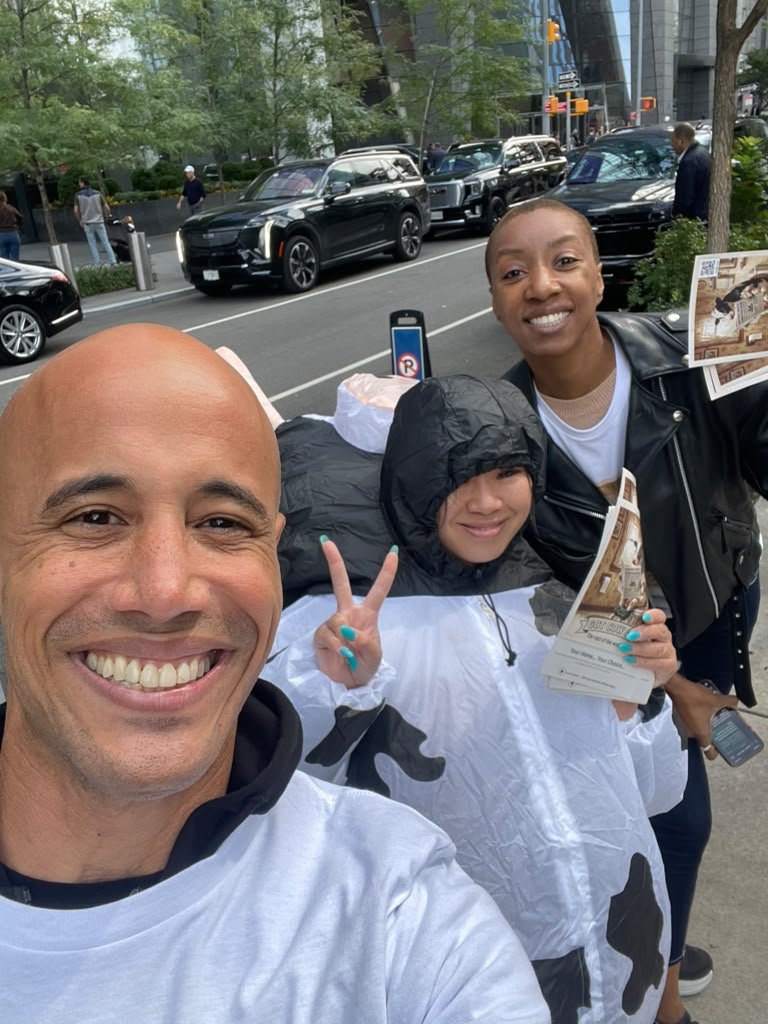
Look for the Got Cow Gas? team around Manhattan this week. Come say hello and grab a flyer.
In the news
Coverage and letters will be posted here as they come in.
Learn about the company at standardcarbon.com and about the fuel at standardcarbon.com/standard-rng.
